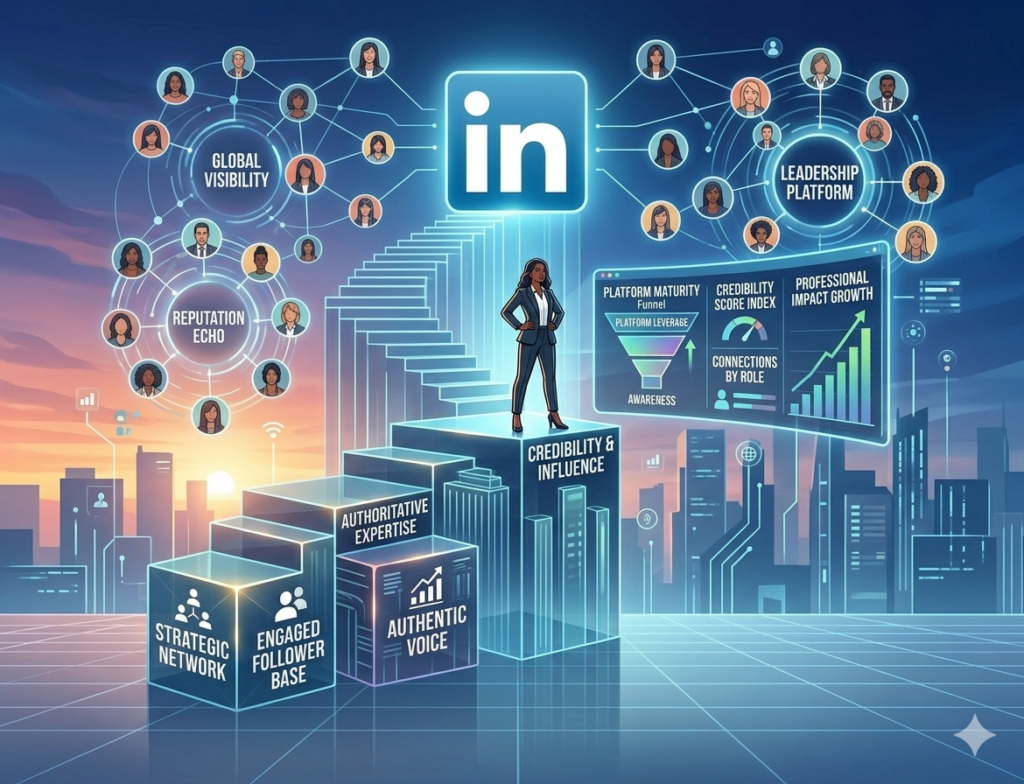
Visibility and influence are not the same thing.
You can be visible on LinkedIn — posting regularly, accumulating connections, showing up in feeds — without any of it translating into the thing that actually matters for leaders: being taken seriously by the right people, in the right rooms, over the long term.
Real influence is quieter than most LinkedIn advice suggests. It doesn’t announce itself. It accumulates, slowly and then all at once, in the kind of reputation that means your name comes up in conversations you’re not part of.
This final piece in the series is about that — about how leaders move from simply being present on LinkedIn to genuinely shaping how they’re perceived in their industry or organisation.
The distinction most LinkedIn advice misses
Most LinkedIn strategy is written for people who want to generate pipeline. More leads, more sales, more clients. The tactics that serve that goal — high-volume posting, connection requests with a pitch attached, metrics-driven content — are not wrong exactly, but they’re solving a different problem.
For leaders, the currency isn’t leads. It’s credibility.
Credibility means that when your name comes up, people associate it with clear thinking, genuine expertise, and a point of view worth listening to. It means that when you enter a new professional context — a new organisation, a new industry conversation, a new network — there’s already something there. A body of work. A reputation. A reason for people to engage with you as someone whose perspective matters.
That’s a different project from building a sales funnel. And it requires a different approach.
The shift from broadcasting to participating
The most common mistake leaders make when they start taking LinkedIn seriously is treating it like a broadcast channel. Post content, wait for people to respond, measure success by how many people saw it.
Influence doesn’t work like that. Influence is relational — it grows through genuine participation in conversations, through the positions you take publicly, through the consistency of your presence over time in the spaces where the conversations your industry cares about are happening.
What does that actually look like?
Being in the room where it’s discussed. On LinkedIn, that means following the conversations that matter in your field — not just posting into your own feed, but knowing whose voices carry weight, what the live debates are, where the interesting thinking is happening. And then participating in those conversations, not just observing them.
Taking positions. Influence requires the willingness to have a view. Not controversy for its own sake — but clear, honest, considered positions on things that matter in your space. The leaders who are quoted, cited, invited to speak, and referred to in industry conversations are almost always the ones who’ve been willing to say what they think, clearly and consistently, over time.
Being generous with what you know. One of the most reliably effective ways to build credibility is to share your expertise freely and without a transaction attached. The leaders who are most genuinely influential on LinkedIn aren’t the ones who tease insight — they’re the ones who give it away and trust that the relationship that builds is more valuable than whatever they might have held back.
Moving connections into real conversations
There’s a moment on LinkedIn that most people either miss or mishandle: the moment when a connection could become a conversation.
Someone comments on your post with something substantive. A connection you’ve had for months has been quietly engaging with everything you write. Someone in your space publishes something that intersects with work you’re doing.
These are invitations. Not to pitch, not to sell, not to ask for anything — but to open a genuine exchange.
A simple, direct message that responds to something specific — something they said, something they wrote, a question their thinking raised for you — is worth more than almost any other LinkedIn activity. Not because of what it immediately produces, but because of what it builds: a real professional relationship, which is the actual substrate of influence.
Practical AI prompt to try: “I want to reach out to [type of person — e.g. a peer in my industry / a leader whose work I admire] after they commented on my post about [topic]. I don’t want to pitch or ask for anything — I just want to open a genuine conversation. Here’s roughly what I want to say: [paste your notes]. Help me write a short, natural message that doesn’t sound like a template.”
AI is useful here for exactly the same reason it’s useful with content: reducing friction between having something to say and actually saying it. The personalisation, the judgment about when to reach out and why — that’s still yours.
Influence inside organisations
Everything above applies to external profile-building — showing up in your industry. But LinkedIn influence also works internally, and this is often underestimated by leaders who think of the platform as purely outward-facing.
When you’re consistently sharing clear thinking, articulating your team’s work, and showing up as a credible voice in your field, it affects how you’re perceived inside your organisation too. Senior leadership notices. Colleagues who’ve never worked directly with you form an impression. Your reputation travels further than your direct relationships.
This matters particularly for leaders who are navigating change, seeking greater scope, or trying to shift the culture or direction of a team or department. Influence isn’t just external currency — it’s internal too.
Some things that work well for internal influence-building:
Celebrating the work of your team publicly. Genuinely, specifically, without taking the credit. This builds your reputation as a leader worth working for and working with.
Articulating what your function or department is working on and why it matters. Not in a promotional way — in a here’s how this connects to something larger way. It demonstrates strategic thinking and makes your work visible in the right way.
Engaging with what your organisation shares publicly. Adding your own perspective, not just resharing. This shows you’re thinking, not just amplifying.
The role of AI in sustaining influence over time
Building influence is a long-term project, and the single biggest reason leaders abandon it is that they run out of time and energy to sustain it.
This is where AI earns its place most clearly — not in generating ideas or replacing your thinking, but in reducing the friction that causes people to go quiet when things get busy.
Staying present when you’re stretched. You don’t need to write a thoughtful 500-word post every week. A short observation, a reaction to something you’ve read, a question you’re sitting with — these take five minutes if you’re not staring at a blank page. AI can help you turn a rough thought into something post-ready in a few minutes.
Keeping track of what you’ve said. Over time, a consistent LinkedIn presence builds up a body of work. AI tools can help you revisit and repurpose that material — finding connections between older pieces, identifying themes, suggesting ways to revisit and extend ideas you’ve explored before.
Preparing for conversations. Before you reach out to someone new, or before a conversation that matters, AI can help you research — finding what they’ve written or said, identifying points of genuine intersection, helping you show up prepared rather than generic.
Practical AI prompt to try: “I have a conversation coming up with [type of person — e.g. a senior leader in the [industry] space]. I want to be able to reference their work and ideas intelligently. Here’s what I know about them: [paste what you know]. What questions should I be prepared to explore, and what might make this conversation genuinely valuable for both of us?”
What influence actually looks like when it’s working
It’s worth being honest about what you’re building towards, because it doesn’t look like what most LinkedIn metrics show you.
When influence is working, the signs are often indirect:
- Someone introduces you to a third party and says “you should talk to Tracy – she really understands this area.”
- An opportunity comes to you rather than you going to it.
- A peer asks your opinion on something before they’ve fully formed their own.
- You’re invited into a conversation – a panel, a project, a working group – because someone thought of you specifically.
- People quote your thinking back to you.
None of those things show up in your LinkedIn analytics. They’re the result of sustained, genuine, consistent presence over time. They’re slow to build and then suddenly evident in a way that feels both surprising and entirely logical.
That’s the compounding effect of influence. And LinkedIn, used well, is one of the best tools leaders have for building it.
Where to begin, or begin again
If you’ve read all three pieces in this series and you’re wondering where to actually start, here’s the honest answer: with the thing that feels most urgent or most underdeveloped.
For most leaders, that’s the profile. It’s the foundation. If it’s not working, nothing else will work as well as it should.
After that — a point of view. Not a content plan, not a posting schedule. A perspective. Something you actually believe about your field, your industry, the people you work with or for. Something worth saying.
Everything else — the content, the conversations, the credibility — builds from there.
Free resource — start here
Download the free guide: 10 AI Prompts to Work Smarter, Sound More Senior, and Stand Out in Your Career. Ready-to-use prompts for women in Officer, Senior Officer, and new manager roles.
The complete system
The AI Career Upgrade System is the complete playbook: 13 advanced AI prompts, communication frameworks, visibility strategies, and a 30-day action plan. Find out more here