Are you going wrong with your personal brand on LinkedIn?
Most LinkedIn profiles are not crafted for the right audience.
They’re written for a hiring manager. A CV in disguise — a chronological list of roles, responsibilities, and achievements that answers the question: what have you done?
But if you’re trying to build influence, attract the right opportunities, or position yourself as a credible voice in your industry, that’s the wrong question entirely. The question your profile needs to answer is: why should I pay attention to you?
There’s a difference when building your personal brand on LinkedIn. And it’s the difference between a profile that sits quietly in the background and one that works for you while you’re not looking.
What a ‘prospect magnet’ profile actually means
The phrase gets thrown around a lot in sales and marketing circles, and it can feel irrelevant if you don’t operate directly in that space. But the underlying idea applies to anyone who wants to be found, trusted, and sought out.
A prospect magnet profile and appropriately pitched personal brand on LinkedIn does three things:
It’s immediately clear who you are and who you help. Not vague or corporate-speak. It’s not a job title that tells people nothing about what you actually do or stand for. Within ten seconds of landing on your profile, someone should know whether you’re relevant to them.
It signals your point of view. Authority on LinkedIn isn’t built by listing credentials — it’s built by demonstrating that you think clearly, that you have a perspective, and that you’re worth listening to. Your profile is the first place that comes through.
It creates a reason to connect. Not a generic “connect with me” — but a felt sense that talking to you would be valuable. That you understand the world they’re operating in.
The three parts of your profile that do the most work
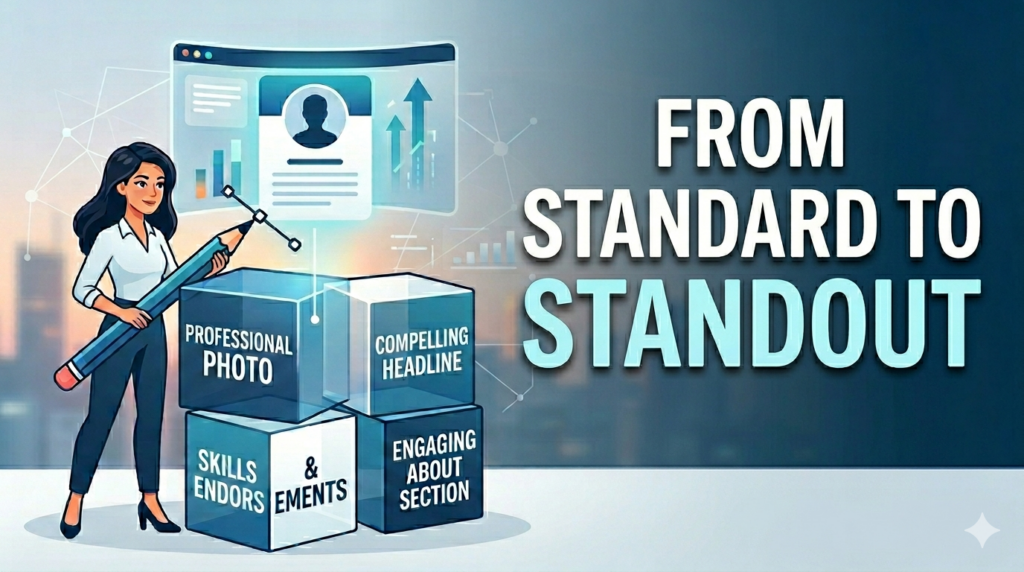
1. Your headline
Your headline is the single highest-visibility piece of text on your profile. It appears next to your name everywhere on LinkedIn — in search results, in comments, in connection requests. Most people use it to write their job title and their company name.
Don’t.
Use it to say what you do, for whom, and what changes as a result. Not in corporate language — in plain, direct language that a person would actually say out loud.
“Helping leadership teams navigate change without losing the people who make them great” tells me far more than “Director of Organisational Development | XYZ Group.”
It doesn’t have to be perfect. It just has to be true, specific, and human.
2. Your About section
This is the most underused real estate on LinkedIn, and the place where your personal brand either comes alive or quietly dies.
Most About sections are written in the third person (odd, given you’re writing it yourself) and read like a press release. Name, role, company, brief summary of career arc, and a vague invitation to connect.
What actually works is something closer to a conversation. Why do you do what you do? What have you seen that others in your space tend to miss? What do you believe about leadership, your industry, change, people — that shapes how you show up?
This is where your story lives. And your story is the thing AI cannot replicate for you.
You can absolutely use AI to help you draft and refine this section — and I’d encourage it. Tools like Claude or ChatGPT are excellent at taking a rough, honest dump of what you want to say and helping you shape it into something coherent and readable. But the raw material — the actual beliefs, experiences, and perspective — has to come from you first.
Practical AI prompt to try:
“Here’s a rough description of what I do and why I do it: [paste your notes]. Help me turn this into a LinkedIn About section that feels personal and direct, not corporate. Around 150-200 words, written in first person.”
Then edit it back to sound like you. The AI will get you 80% there. The remaining 20% is the part that makes it yours.
3. Your Featured section
Most people leave this blank or use it to link to their company website. That’s a missed opportunity.
Your Featured section is visible real estate — prime positioning for whatever you most want people to see. A piece of writing that demonstrates your thinking. A talk you’ve given. A newsletter you publish. A case study or project you’re proud of.
Think of it as the proof behind the promise of your headline.
The personal brand question you actually need to answer first
Before you touch your profile, there’s a more fundamental question worth sitting with.
What do I want to be known for?
Not what your employer wants you to be known for. Not a laundry list of skills. One clear thing — a perspective, a speciality, a way of seeing the world — that you’d be happy to be associated with for the next three to five years.
For leaders especially, this is often the hardest part. You may have built your career being excellent at a broad range of things. Narrowing to a point of view can feel like leaving things out.
But on LinkedIn, trying to speak to everyone is the surest way to reach no one. The leaders who build genuine influence on the platform are almost always the ones who’ve committed to a clear and consistent perspective.
AI can actually be really helpful here too — not to decide your positioning for you, but to help you think it through. Try asking:
Practical AI prompt to try:
“Based on these notes about my background and what I care about professionally [paste notes], what are three distinct positioning angles I could own on LinkedIn? For each one, describe who it would attract and what content it would naturally lead to.”
Use the output as a thinking tool, not a final answer. The goal is to surface the options so you can choose, not to outsource the choosing.
A note on authenticity (without the buzzword)
Authenticity is one of those words that’s been used so often it’s started to lose meaning. But the underlying idea matters, especially for leaders.
People can tell when a profile has been written to impress rather than to connect. They can feel the performance. And on a platform built on professional relationships, that slight inauthenticity creates distance rather than connection.
The leaders who attract the most meaningful opportunities through LinkedIn tend to be the ones who’ve decided to show up as themselves — with their actual opinions, their real interests, the things they genuinely find difficult as well as the things they’re good at.
Your profile doesn’t need to be perfect. It needs to be true.
Where to start
If you do nothing else after reading this, do this one thing: rewrite your headline. Take your current job title, look at it honestly, and ask yourself whether someone who doesn’t know you would understand why they should pay attention to you based on that line alone.
If the answer is no — which it usually is — spend twenty minutes on a new version. Use AI to help you generate options. Then pick the one that feels most like you, and test it.
Everything else can follow from there.
Free resource — start here
Download the free guide: 10 AI Prompts to Work Smarter, Sound More Senior, and Stand Out in Your Career. Ready-to-use prompts for women in Officer, Senior Officer, and new manager roles.
The complete system
The AI Career Upgrade System is the complete playbook: 13 advanced AI prompts, communication frameworks, visibility strategies, and a 30-day action plan. Find out more here