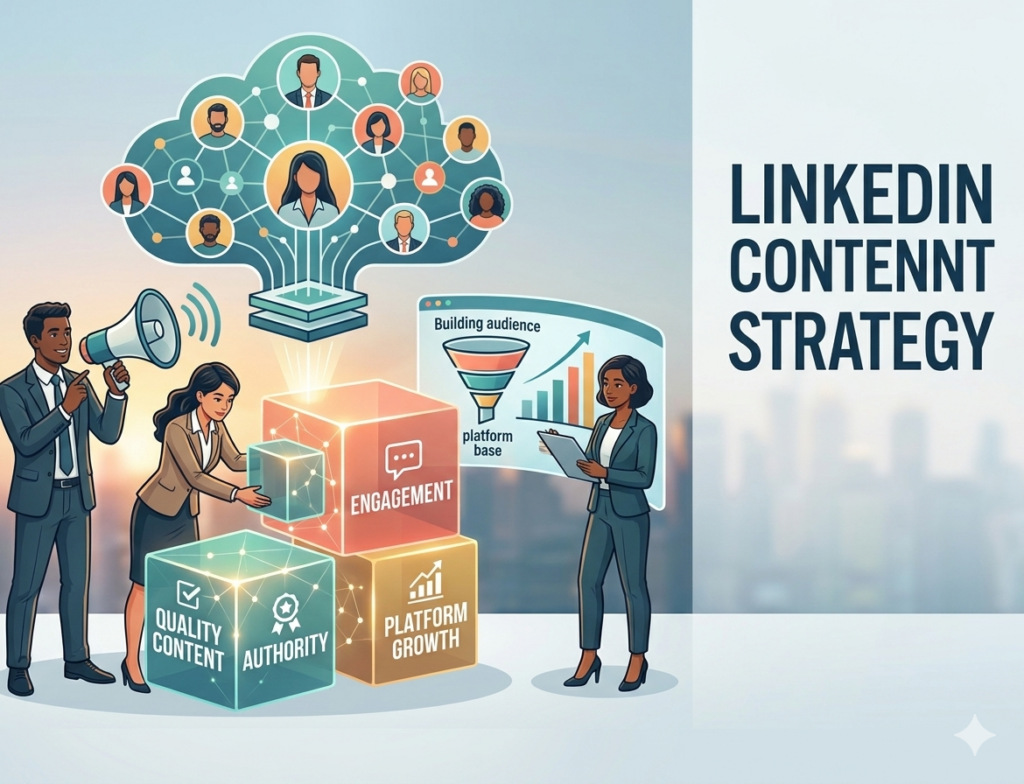
There’s a metric that LinkedIn quietly encourages you to care about that is almost entirely useless.
Likes.
Not because engagement doesn’t matter — it does — but because a post that gets a lot of likes and a post that builds your authority and attracts the right people are often completely different posts. And if you’re optimising for one, you’re frequently undermining the other.
This is the core tension in building a meaningful LinkedIn presence as a leader. And understanding it is what separates people who accumulate a large following of vague interest from people who build a smaller, more engaged audience that actually cares about what they think.
The difference between reach and authority
Reach is how many people see your content. Authority is whether the right people take you seriously.
You can have enormous reach with very little authority — think of the LinkedIn posts that go viral because they’re mildly motivational or relatably funny. And you can have modest reach with significant authority — a smaller audience of exactly the right people who read everything you write and refer others to your work.
For most leaders, authority is the asset worth building. Reach is a byproduct of that, not the goal itself.
What builds authority on LinkedIn?
Consistent point of view. Not posting every day — posting with intention. Content that reflects a perspective, not just activity. People follow leaders who think clearly and say things worth reading, not leaders who post frequently about nothing in particular.
Specificity over breadth. The counterintuitive truth about building influence is that the more specific your focus, the more broadly you tend to be recognised. If you write about leadership in general, you’ll attract a general audience. If you write about what happens to team culture during organisational restructure, you’ll attract people dealing with exactly that — and they’ll tell others.
Willingness to have a view. The safest LinkedIn posts are also the most forgettable. “Great to attend this conference — so many insights.” That’s not content. Content that builds authority takes a position, offers an analysis, shares something someone might push back on. That’s what creates real engagement — the kind that leads to conversations, not just clicks.
What ‘content that generates leads’ actually means
The phrase “content that generates leads” belongs mostly to the sales and marketing world, but there’s a version of it that applies to leaders too — you just need to translate it.
For a leader, a “lead” isn’t a potential customer. It’s a potential collaborator. A speaking invitation. A person in your industry who decides you’re worth having a conversation with. A recruiter who’d never have considered you who now recognises your name. A peer who reaches out because your thinking resonated.
Content generates those outcomes when it does one of a few things:
- Teaches something useful. Not in a tutorial way — in a this person understands things I care about way. Share what you know. Share frameworks you use. Share the things you’ve learned that took you longer to figure out than they should have.
- Articulates something people already feel but haven’t said. This is one of the most powerful things you can do with content. When someone reads something and thinks yes, exactly that — you’ve created a connection that goes beyond the post itself.
- Shares honest experience. Not performative vulnerability, not crisis-as-content, but genuine reflection on what leadership actually looks like from the inside. The hard calls. The things that didn’t work. What changed your thinking.
Where AI genuinely helps — and where it doesn’t
Content creation is where AI tools have become genuinely useful for leaders, and also where they’re most easily misused.
AI is excellent at:
Breaking through the blank page. The hardest part of consistent content is starting. If you’ve got a rough idea — a thing that happened this week, a conversation that stuck with you, a belief you’ve been sitting with — you can talk it out with an AI tool and get a structured draft back in minutes. That draft won’t be you. But it’ll be a starting point that’s easier to edit than to create from nothing.
Practical AI prompt to try: “I want to write a LinkedIn post about [topic/experience/observation]. Here’s the rough idea: [paste your notes or just talk it through]. Help me write a 200-word post with a strong opening line that doesn’t start with ‘I’. The tone should be direct and honest, not motivational.”
Repurposing content across formats. If you’ve written a longer article, given a talk, or been in a conversation that generated good thinking, AI can help you extract the core ideas and turn them into several shorter posts, a newsletter section, or talking points. One idea, multiple expressions.
Practical AI prompt to try: “Here’s an article I’ve written [paste article]. Pull out five distinct ideas from this that could each become a standalone LinkedIn post. For each one, give me an opening line.”
Editing for clarity and concision. Leaders often write the way they talk in meetings — thoroughly. AI is good at helping you cut that to something tighter without losing the point.
What AI isn’t good at — and this matters:
Generating your perspective. An AI tool will give you content that sounds plausible, but it won’t give you content that sounds like you — because it doesn’t know what you actually think. It’s drawing on a vast average of how people talk about things, which produces something vaguely professional and entirely generic. Filling in your perspective is still entirely your job.
Knowing what’s worth saying. This is a judgment call that requires your experience and your read of your specific industry and audience. AI can help you say it better; it can’t tell you whether it’s worth saying at all.
The practical implication: use AI as a production tool, not a thinking tool. Do your thinking first. Then bring in the AI to help you express it more efficiently.
Building the audience itself
Content is only half of the equation. Who you’re connecting with matters as much as what you’re saying.
The default LinkedIn approach — accepting every connection request, connecting with anyone who seems vaguely professional — produces a feed that’s noisy and an audience that’s unfocused. You end up speaking to everyone and reaching no one in particular.
A more intentional approach:
Be deliberate about who you connect with. Think about the people whose attention you actually want — people in your industry, potential collaborators, leaders you admire, people who are working on problems you care about. Connect with intention rather than accumulation.
Engage before you broadcast. One of the most underrated LinkedIn strategies is simply commenting thoughtfully on other people’s content before worrying about your own. Leaving a genuine, substantive comment on a post by someone in your space puts your name and perspective in front of their entire audience. Do this consistently and you’ll grow faster than most content strategies will build you.
Follow the conversation, not just the content. LinkedIn rewards participation in discussions, not just posting into the void. When a topic that’s relevant to your area catches fire, being part of that conversation — with a clear point of view — is more valuable than a standalone post.
What consistency actually means
You’ll hear “consistency is key” repeated endlessly in advice about LinkedIn, and it’s true — but it’s also misunderstood.
Consistency doesn’t mean daily posting. It means showing up regularly enough that people don’t forget you exist, and showing up with a consistent enough perspective that people know what to expect from you.
For most leaders, that means two or three posts a week and genuine participation in conversations. That’s achievable. That’s sustainable. And that’s enough to build something meaningful over six to twelve months.
AI can help with the consistency piece too — by reducing the friction of production, so that the weeks when you’re busy and distracted don’t become silent months that break the momentum you’ve built.
The compounding effect
Here’s the thing about building a LinkedIn audience as a leader: it compounds in a way that most other professional development activities don’t.
Each piece of content that lands adds a few more people to your world. Every thoughtful comment puts your name in front of a new audience. Each connection that becomes a conversation opens a door you didn’t know existed.
None of it happens fast. But the leaders who’ve built genuine influence on the platform — who are invited to speak at things, who attract the right opportunities, whose names come up in rooms they’re not in — almost all got there through this kind of patient, intentional accumulation.
The platform rewards the long game. Which means starting now matters more than starting perfectly.
Free resource — start here
Download the free guide: 10 AI Prompts to Work Smarter, Sound More Senior, and Stand Out in Your Career. Ready-to-use prompts for women in Officer, Senior Officer, and new manager roles.
The complete system
The AI Career Upgrade System is the complete playbook: 13 advanced AI prompts, communication frameworks, visibility strategies, and a 30-day action plan. Find out more here